ZIRO - Professional Web Design & Development Agency
ProcesUsługiDlaczego Ziro?FAQBlogAktualizacjeProdukty

Notebook

Audio summaries generated by AI

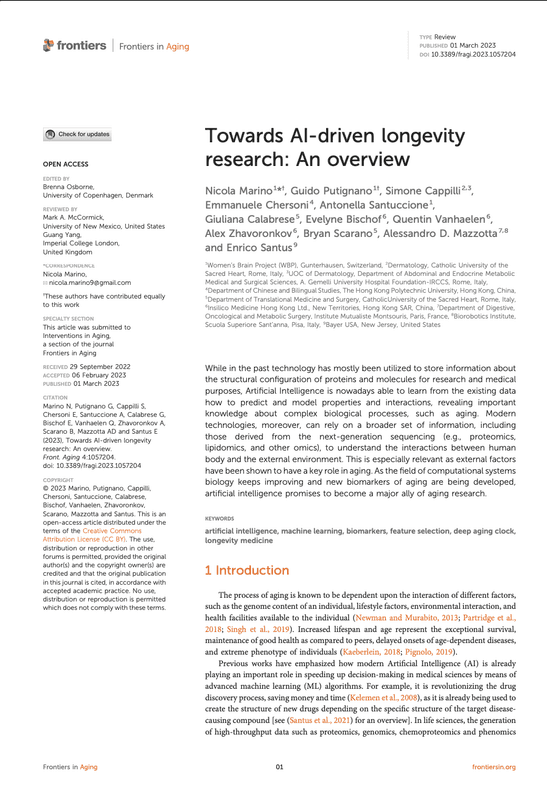
Towards AI-driven longevity research: An overview

Towards AI-driven longevity research: An overview

Nov 30, 2025

This academic overview explores how Artificial Intelligence (AI) is revolutionizing the study of aging by moving beyond basic data storage to sophisticated modeling and prediction of complex biological processes. The paper systematically examines AI applications across the established hallmarks of aging, organizing its analysis into three categories: primary, antagonistic, and integrative factors. Specific examples illustrate the use of deep learning algorithms to automate the assessment of damage indicators like genomic instability and machine learning methods to identify novel aging-related proteins (proteostasis). The authors stress that leveraging massive datasets, including high-throughput omics data, enables a more comprehensive understanding of the systemic and multifaceted nature of aging. Ultimately, the text argues that AI is foundational to longevity medicine, providing tools like "deep aging clocks" for tracking a patient's biological age and accelerating the development of therapeutic interventions to extend human healthspan.
14 min
14 min
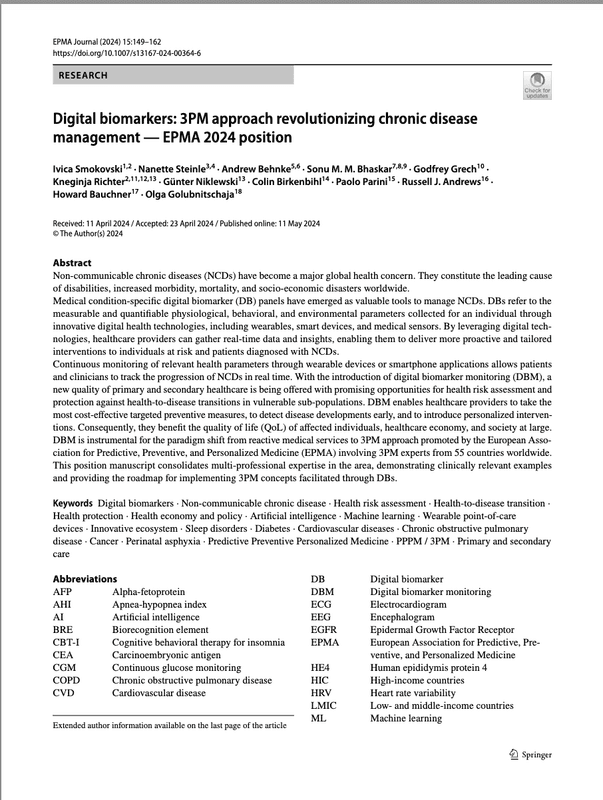
Digital biomarkers: 3PM approach revolutionizing chronic disease management - EPMA 2024 position

Digital biomarkers: 3PM approach revolutionizing chronic disease management - EPMA 2024 position

Nov 29, 2025

The provided text is a 2024 position manuscript from the European Association for Predictive, Preventive, and Personalized Medicine (EPMA) advocating for the revolutionary use of digital biomarkers (DBs) in managing chronic diseases worldwide. DBs are defined as measurable physiological, behavioral, and environmental parameters collected continuously via wearable devices, smart technologies, and medical sensors. This technology shifts medical services from reactive treatment toward the proactive Predictive, Preventive, and Personalized Medicine (3PM) approach. The source details how Digital Biomarker Monitoring (DBM) enables healthcare providers to conduct real-time health risk assessments and tailor interventions for conditions such as diabetes, cardiovascular diseases, and cancers. Crucially, the analysis of this extensive real-time patient data is dependent upon the integration of Artificial Intelligence (AI) and Machine Learning (ML) to predict disease progression and optimize outcomes. Finally, the authors address the increasing importance of telemedicine while acknowledging challenges concerning data security and public trust in these advanced systems.

14 min
14 min
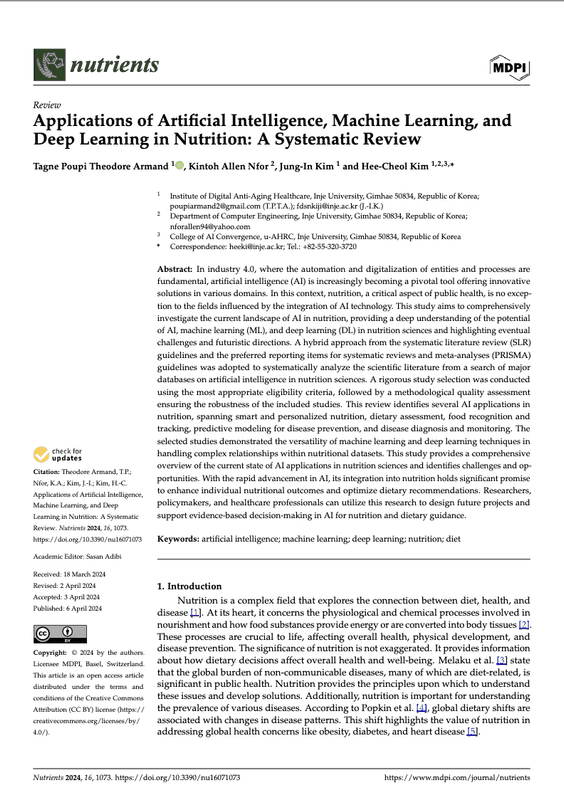
Applications of Artificial Intelligence, Machine Learning, and Deep Learning in Nutrition- A Systematic Review

Applications of Artificial Intelligence, Machine Learning, and Deep Learning in Nutrition- A Systematic Review

Nov 29, 2025

The academic paper is a systematic review that investigates the growing implementation of artificial intelligence (AI), machine learning (ML), and deep learning (DL) within the domain of nutrition science. Using a structured methodology, the authors analyzed literature published between 2019 and 2024 to identify how these technologies are currently being applied. The review successfully categorized AI’s utility into five principal areas: designing smart and personalized nutrition plans, improving the accuracy of dietary assessment, enabling automated food recognition and tracking, establishing predictive modeling for disease prevention, and assisting in disease diagnosis and monitoring. While showcasing the significant potential of AI to revolutionize nutritional outcomes and public health initiatives, the authors also discuss considerable challenges. These obstacles include issues related to data quality and availability, the risk of algorithmic bias, and the necessity of establishing clear ethical frameworks for implementation.

16 min
16 min
Hierarchical Reasoning Model: Brain-Inspired AI for Complex Tasks

Hierarchical Reasoning Model: Brain-Inspired AI for Complex Tasks

Nov 29, 2025

This research introduces the Hierarchical Reasoning Model (HRM), a novel recurrent neural network architecture designed to overcome the computational depth limitations and data inefficiencies of current Large Language Models (LLMs) that rely on Chain-of-Thought (CoT) methods. Inspired by the human brain's organization, HRM features two coupled recurrent modules: a slow, high-level module for abstract planning and a fast, low-level module for rapid computation. This design achieves superior computational depth through hierarchical convergence and is trained efficiently using a one-step gradient approximation that avoids memory-intensive backpropagation through time. Despite having only 27 million parameters and utilizing minimal training data, HRM achieves state-of-the-art accuracy on challenging benchmarks like the Abstraction and Reasoning Corpus (ARC), complex Sudoku, and optimal maze navigation. The model's success confirms that this hierarchical, latent reasoning approach significantly outperforms leading CoT models on tasks requiring deep algorithmic search. The authors propose that HRM represents a viable foundation for developing Turing-complete universal computation systems.

18 min
18 min
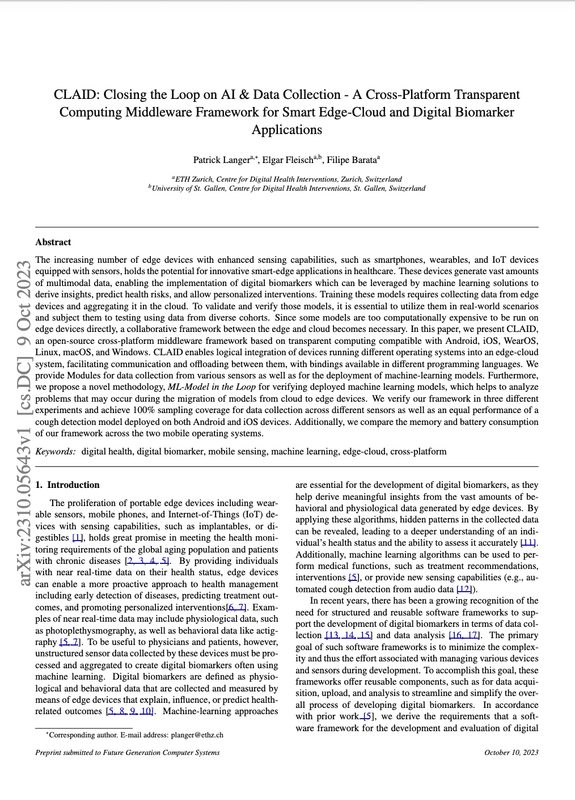
CLAID- Closing the Loop on AI & Data Collection

CLAID- Closing the Loop on AI & Data Collection

Nov 29, 2025

The academic paper presents CLAID, an open-source, cross-platform middleware framework specifically designed to facilitate the development and validation of digital biomarkers using data gathered from edge and cloud resources. This system utilizes transparent computing principles to logically integrate diverse devices. Including smartphones, wearables, and servers. Allowing them to seamlessly exchange data and distribute computational tasks through offloading. The framework achieves modularity by using flexible components called Modules for core functions like data collection from multiple sensors and the deployment of machine learning models across platforms such as Android, iOS, and Linux. Furthermore, the paper proposes a new verification method, the ML-Model in the Loop, to systematically test the performance and reliability of models migrated to edge devices. Evaluation confirms CLAID's robust functionality, achieving 100% sampling coverage during extended data collection experiments while assessing the system's memory and battery consumption across different configurations.

15 min
15 min
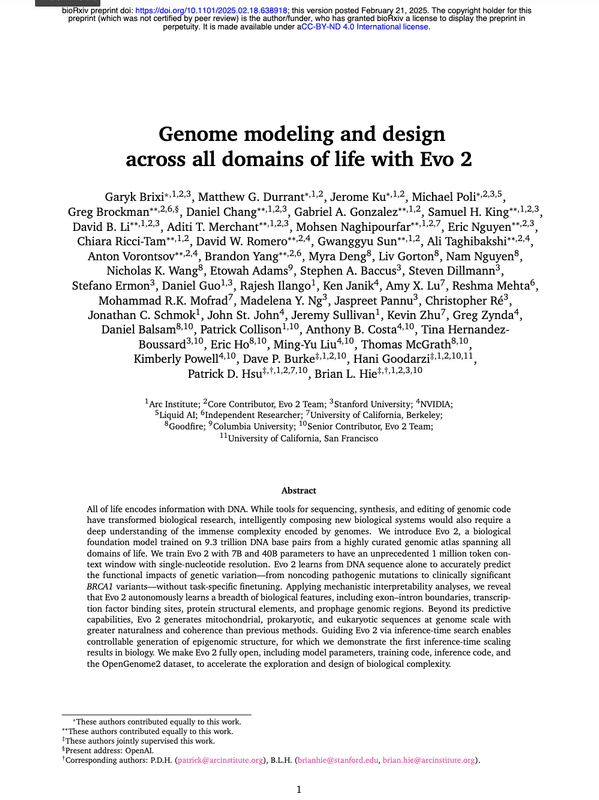
Evo 2: A Foundation Model for Genomic Sequence Analysis

Evo 2: A Foundation Model for Genomic Sequence Analysis

Nov 28, 2025

The source introduces Evo 2, a massive biological foundation model trained on 9.3 trillion DNA base pairs from the newly released OpenGenome2 dataset, spanning all domains of life. Utilizing the StripedHyena 2 architecture, the model is scaled up to 40 billion parameters and features an unprecedented 1 million token context window for single-nucleotide resolution. Evo 2 demonstrates powerful zero-shot prediction capabilities, accurately assessing the functional impact of diverse genetic variations—including clinically relevant noncoding mutations—on protein, RNA, and whole organism fitness without specialized training. The model also excels at genome-scale generation, producing novel mitochondrial and prokaryotic sequences, and enabling controllable epigenomic design by guiding generation with external prediction models. Furthermore, analysis using Sparse Autoencoders (SAEs) shows Evo 2 autonomously learns complex, interpretable biological features such as exon–intron boundaries and transcription factor binding sites. Critically, the authors have made Evo 2 and the OpenGenome2 dataset fully open to the public to accelerate scientific exploration and design.

22 min
22 min
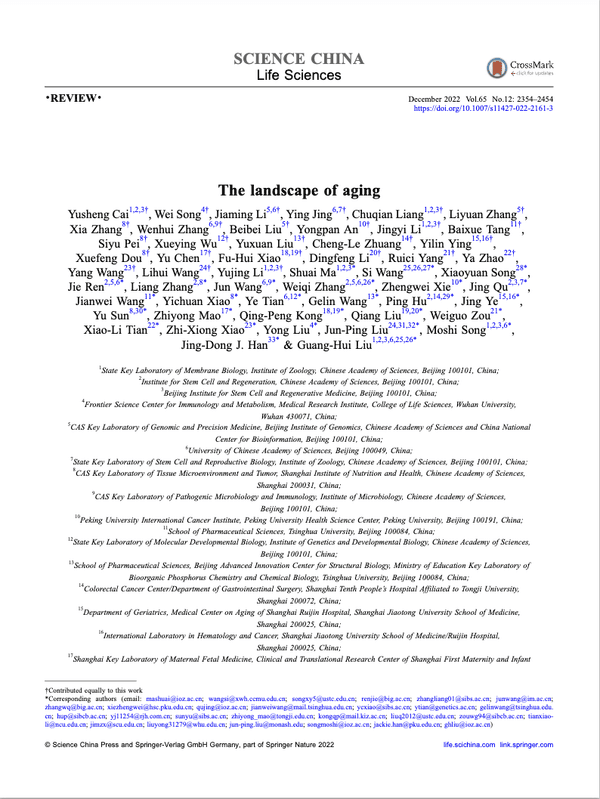
The landscape of aging

The landscape of aging

Nov 28, 2025

This extensive scientific review examines the multifaceted biological causes and consequences of aging across molecular and systemic scales. A significant focus is placed on the core cellular mechanisms of degeneration, including cellular senescence and associated processes like telomere attrition, as well as epigenetic dysregulation and the activation of retrotransposable elements that lead to DNA damage. The text systematically details the resulting physiological decline across major organ systems, specifically highlighting the stiffening and remodeling involved in vascular and cardiac aging and the loss of regenerative capacity in skeletal muscle and bone. Furthermore, the authors discuss metabolic changes, such as impaired autophagy and altered nutrient signaling, while also noting the genetic markers associated with human longevity. Finally, the review addresses promising therapeutic strategies, including the use of targeted senolytic molecules and the application of cutting-edge tools like single-cell multiomics to advance future aging interventions.

14 min
14 min
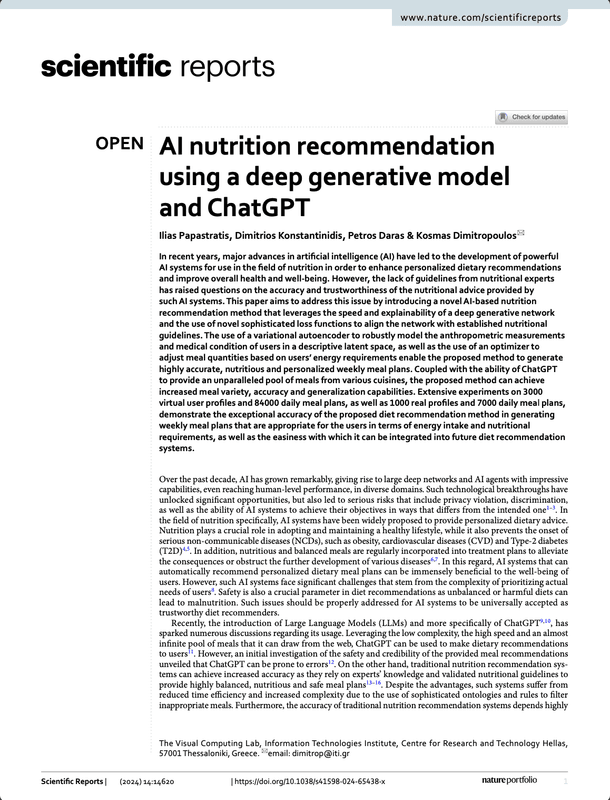
AI-Powered Personalized Nutrition Recommendations

AI-Powered Personalized Nutrition Recommendations

Nov 27, 2025

The provided text outlines a novel AI-based nutrition recommendation system designed to provide highly accurate, personalized weekly meal plans. This architecture utilizes a deep generative network to model user data, including anthropometric measurements and medical conditions, in a descriptive latent space. Critically, it incorporates established nutritional guidelines via unique loss functions to ensure that the generated plans are balanced and safe, addressing the known inaccuracies of general models like ChatGPT. An integrated optimizer dynamically adjusts meal portions to guarantee the prescribed energy intake matches user requirements, achieving zero caloric deviation in testing. Additionally, the system employs ChatGPT to expand the available meal database by sourcing nutritionally equivalent options from diverse cuisines, enhancing generalization and variety. This method demonstrates that combining the speed of AI with expert-validated nutritional rules results in highly trustworthy dietary advice.

17 min
17 min
Towards AI-driven longevity research: An overview

Towards AI-driven longevity research: An overview

00:00:00 / 00:00:00
ZIRO Healthcare Solutions
Located in PolandProjektujemy z pasją w Polsce.

Ziro to firma technologiczna, w której design odgrywa kluczową rolę. Łączymy usługi projektowe z rozwojem produktów cyfrowych dla branży zdrowotnej, oferując projektowanie UI/UX, branding i rozwój produktów dla firm i startupów z sektora opieki zdrowotnej.

ul. Mogilska 43, 31-545 Kraków, Poland

nikhil@ziro.health
processservicesexplore serviceswhy Ziro?FAQsnotebook

Pozostań w kontakcie

InstagramLinkedInHealth by DesignX (Twitter)
Inkubowani przezLogo Kraków Miastem Startupów
Przyspieszeni przezLogo Klaster LifeScience Kraków
CzęśćLogo Małopolska Agencja Rozwoju Regionalnego

© 2025 ZIRO sp. z o.o. Wszystkie prawa zastrzeżone

Produkty

Ziro Fit
Ziro Notebook
Ziro Agency